… the North Dakota State University football team.
I mean. It paid off for awhile.
***********************
From the Grand Forks Herald.
You need to register to get to the article.
… the North Dakota State University football team.
I mean. It paid off for awhile.
***********************
From the Grand Forks Herald.
You need to register to get to the article.
A poem about the spring, by Robert Louis Stevenson.
Flower God, God of the Spring
Flower god, god of the spring, beautiful, bountiful,
Cold-dyed shield in the sky, lover of versicles,
Here I wander in April
Cold, grey-headed; and still to my
Heart, Spring comes with a bound, Spring the deliverer,
Spring, song-leader in woods, chorally resonant;
Spring, flower-planter in meadows,
Child-conductor in willowy
Fields deep dotted with bloom, daisies and crocuses:
Here that child from his heart drinks of eternity:
O child, happy are children!
She still smiles on their innocence,
She, dear mother in God, fostering violets,
Fills earth full of her scents, voices and violins:
Thus one cunning in music
Wakes old chords in the memory:
Thus fair earth in the Spring leads her performances.
One more touch of the bow, smell of the virginal
Green – one more, and my bosom
Feels new life with an ecstasy.
***********************************
Flower god, god of the spring, beautiful, bountiful,
Cold-dyed shield in the sky, lover of versicles,
I thought at first this was vesicles, and was all ready to find a reason why a “small membrane-enclosed sac that can store or transport substances” made perfect sense in a poem praising the spring… But no – a versicle is a sort of prayer-leader. It’s the first line, usually uttered by a priest, of a call-and-response bit of prayer.
Priest: O Lord, open thou our lips:
People: And our mouth shall shew forth thy praise.
Priest: O God, make speed to save us:
People: O Lord, make haste to help us.
Priest: Glory be to the Father, and to the Son, and to the Holy Ghost.
People: As it was in the beginning, is now, and ever shall be, world without end. Amen.
Priest: Praise ye the Lord.
People: The Lord’s name be praised.
Like that. The whole idea of the poem is that spring initiates life, and calls us back into life, after the winter. It’s a heavenly versicle that draws from us a very intense response. The flower god reveals itself now in the blue sky shielding us from winter.
Here I wander in April
Cold, grey-headed; and still to my
Heart, Spring comes with a bound, Spring the deliverer,
When I get to Heart, vesicle becomes versicle becomes ventricle … and as I wander in my head, I find icicle and canticle are there too — icicle because the poet has repeated “cold,” and canticle because once I know what versicle means, I’m thinking of song… But anyway, the poet, who walks in a spring wood, feels himself to be unspringlike — old, sad; yet the power of spring is so great that even he feels delivered from age and sorrow by it, brought from gray into a colorful world by it.
Spring, song-leader in woods, chorally resonant;
Spring, flower-planter in meadows,
The poet widens out the versicle idea. Spring is indeed a song-leader, making the trees and wind resound, respond to its leading voice.
Child-conductor in willowy
Fields deep dotted with bloom, daisies and crocuses:
The poet continues to play out his musical metaphor. Leader, conductor of music; and conductor of the children through the woods. Even dotted has musical resonance.
Here that child from his heart drinks of eternity:
O child, happy are children!
She still smiles on their innocence,
She, dear mother in God, fostering violets,
Fills earth full of her scents, voices and violins:
Far from grey-headed, the poet now, under the influence of spring, is a child again, having been led back to a state of eternal youth. Violets, voices, and violins – nature, humanity, and music all quicken under the flower god.
Thus one cunning in music
Wakes old chords in the memory:
Thus fair earth in the Spring leads her performances.
One more touch of the bow, smell of the virginal
Green – one more, and my bosom
Feels new life with an ecstasy.
Subtle, cunning, what the earth sings — a warble, swaying branches, a brook in motion. There are choral resonances to all of these sounds together, but they also form personal memory chords. Spring, the poet repeats, leads the earth-performance, the song of the earth, to get Mahlerian about it… And then the poet ends with images that complete his metaphor so beautifully and subtly: All it takes is a touch, a scent, of spring, and the poet feels reborn. The bow of the violin is also the bough of the tree that taps him; the smell of virginal grass is also music from the virginal, a kind of harpsichord.

Oh. Whoops. Too late. You were supposed to read this post while listening to this. Written for virginal.
A professor at the University of Maine looks at the athletics program there and writes a letter to the student newspaper.
I have read the recent articles in The Maine Campus on the Department of Athletics. Overall, I think they were done well, but you let the director of athletics get away with something in your interview.
At the end of Monday’s article, Athletic Director Blake James said: “I don’t think we should be funded like Ohio State, Florida, Penn State or any of the big programs.”
I bet he doesn’t. According to a database of the finances of public university athletic programs available on USA Today’s Web site, both Ohio State and Florida athletics received $0.00 of direct university support in 2008-2009, while University of Maine Athletics received $9,548,688.
It is important to note that the “big programs” are successful at self-sufficiency by large ticket sales, alumni donations, conference guarantees for away games, etc.
In contrast, UMaine provides well over 50 percent of the budget for the athletics program here — money that comes from the same source that should be used to support the mission of the university: education and research.
For the most part, the academic programs generate more than they receive — my own Department of Physics has a budget of $1.9 million and generated $2.5 million in student credit hours.
The bottom line is the academic programs are being forced to support a bloated administration and a not particularly successful athletics program — with the possible exception of hockey. This is unsustainable, and the Academic Program Prioritization Working Group had no chance of “achieving sustainability” since they were directed by administration to focus solely on proposing cuts to academics.
Dean Astumian
Professor of physics
It’s late on an April afternoon, and I’m wondering why drifts of white moths are suddenly floating by my sixth floor window at George Washington University.
Moths? This high up?
I open the window and lean out, listening to police sirens screaming away at the site of the nuclear summit, and they’re petals. They’re thousands of dogwood petals pulled up to the sixth floor by the wind.
They seem in no hurry to settle back to the ground, so I lean against the window sill and consider the cloud suspended at the level of my eye.
Usually what you see flying by here are helicopters and airplanes. Also white birds. Some sort of gull, I think.
Down at ground level, ambulances quietly enter and exit the hospital driveway. The middle of UD‘s view is all about the new skyscraper where the old hospital used to be. The university’s engineering department, down the hall from UD‘s office, follows the construction with great excitement, stapling onto a bulletin board an array of photographs chronicling each stage of the building.
Having taught her classes, UD prepares to walk to the Foggy Bottom metro and go home. She takes her soft black leather notebook in which she will continue to chronicle not the streamlined evolution of skyscrapers but the faltering progression of her life. She’s kept a diary – not University Diaries, just a diary – since she was thirteen.
She calls Mr UD from Metro Center. He doesn’t teach today and will meet her at Grosvenor, the stop closest to their house.
*************************
And there he is, in their bright red car, the car they’ve named Walentynka (Valentine). UD washed Walentynka last weekend, and she’s looking insanely bright red at the moment.
“So David says they’re getting family physician recruitment calls from all sorts of places around the country where they wouldn’t want to live,” UD says, bringing Mr UD up to date on a friend of theirs whose wife has finished a residency. “Quoting David: Some east-bumfuck-back-of-nowhere place where I wouldn’t even want to see healthy people… But it’s a theory of mine [Mr UD cringes in preparation for one of UD‘s theories.] that there are, strictly speaking, no uninteresting places in the world. There are:
1. interesting places;
2. uninteresting places NEAR interesting places; and
3. places interesting by virtue of being uninteresting.”
“Tell me more about the third one.”
“Take Bismarck, North Dakota. Say you had to move to Bismarck, North Dakota. Flat. Underpopulated. Bad weather. Conveniently located just to the north of South Dakota. And yet its very nothingness has inspired, for instance, all those Kathleen Norris books – very interesting books, as it turns out – about the spiritual fascination of nothingness.”
“Let’s buy a house in Bismarck. I’ll check it out on the web. We know absolutely nothing about Bismarck. Right? Absolutely nothing.”
“Absolutely nothing.”
So after dinner at a new Japanese place on the Rockville Pike, we drive home and Mr UD gets to work.
I’m sitting up in bed, gazing at the rather threatening wall of green outside our picture windows (I don’t garden or even cut back very much this part of our acre – it’s the dog’s playground – and the wildlife is really encroaching.), when Mr UD bustles in with the Bismarck results.
“It’s on a river! The Missouri I think. For seven hundred thousand dollars you can get a beautiful house set right on the riverbank. We’re retiring to Bismarck.”
… comments on the DUI arrest of a University of Kentucky basketball coach. It’s the coach’s fourth DUI arrest.
Enough has to be enough — even for a Kentucky basketball coach.
Emily Harnden, University of Illinois:
[Many of our classes post] lecture notes, labs, assignments, paper topics, vocabulary lists, extra credit opportunities and even online office hours …
[Although we all laugh] at what a “joke of a class” these technologically inclined classes may seem, in reality [it’s not] that funny. Because guess what? We’re all paying for that “joke of a class.” Whether it is you personally or your parents, sooner or later, we’re going to realize the joke’s on us. For even though I love to joke around about how easy some of my classes have been, the fact of the matter is the only thing it is helping is my GPA…
… By forfeiting their right to teach students face-to-face, professors who rely heavily on online-based coursework are giving us an easy out for our education…
On the bright side — it’s a step up from a diploma mill. It’s accredited.
… the Poles will be leaning – very visibly – in the next few weeks of masses and memorials make the most recent New York Times column by Stanley Fish particularly topical.
He’s reviewing a book by Jurgen Habermas, titled An Awareness of What is Missing, in which Habermas — long associated with the view that “the authority of the holy,” is in the process of being successfully replaced, in modern, secular culture with “the authority of an achieved consensus” — seems to change his mind. Fish writes:
In recent years … Habermas’s stance toward religion has changed. First, he now believes that religion is not going away and that it will continue to play a large and indispensable part in many societies and social movements. And second, he believes that in a post-secular age — an age that recognizes the inability of the secular to go it alone — some form of interaction with religion is necessary: “Among the modern societies, only those that are able to introduce into the secular domain the essential contents of their religious traditions which point beyond the merely human realm will also be able to rescue the substance of the human.”
What’s missing, then, is the “substance of the human,” “normative guidance” …
[The] modern Liberal state, … Habermas reminds us, maintains “a neutrality . . . towards world views,” that is, toward comprehensive visions (like religious visions) of what life means, where it is going and what we should be doing to help it get there. The problem is that a political structure that welcomes all worldviews into the marketplace of ideas, but holds itself aloof from any and all of them, will have no basis for judging the outcomes its procedures yield. Worldviews bring with them substantive long-term goals that serve as a check against local desires. Worldviews furnish those who live within them with reasons that are more than merely prudential or strategic for acting in one way rather than another.
The Liberal state, resting on a base of procedural rationality, delivers no such goals or reasons and thus suffers, Habermas says, from a “motivational weakness”; it cannot inspire its citizens to virtuous (as opposed to self-interested) acts because it has lost “its grip on the images, preserved by religion, of the moral whole” and is unable to formulate “collectively binding ideals.”
The liberal citizen is taught that he is the possessor of rights and that the state exists to protect those rights, chief among which is his right to choose. The content of what he chooses — the direction in which he points his life — is a matter of indifference to the state which guarantees his right to go there just as it guarantees the corresponding rights of his neighbors (“different strokes for different folks”). Enlightenment rational morality, Habermas concludes, “is aimed at the insight of individuals, and does not foster any impulse toward solidarity, that is, toward morally guided collective action.”
***************************
You see the moral paralysis Habermas has in mind in a recent interview about the burqa with historian Joan Wallach Scott in Salon.
Scott insists that “One can’t assume …that [the burqa] signifies oppression.”
Why then, her interviewer asks, “does the [burqa] so dominate conversations about the rights of Muslim women?”
Well, that’s an interesting question. I think it is a way of avoiding talking about the discrimination Muslims (men and women) face in Western societies, a way of indicating “our” superiority to “them,” of blaming “them” for the discrimination they suffer, a way of depicting “them” as less modern, less enlightened than “us.”
There are, that is, no standards of enlightenment or modernity among us. As Scott’s quotation marks suggest, there’s no us. There are only bunches of people making choices and suffering discrimination as a result of some of those choices.
Muslim women, Scott says, must be choosing the burqa. Some of them must be choosing it. Enough of them for our liberal states to honor their choice.
We’re forced into this assumption because we have no general moral point of view from which we could assume otherwise, or, more importantly, from which we could put aside questions of the motivation of these women and instead defend our own set of collective moral principles.
Scott seems unable to perceive, in other words, the evisceration of “the substance of the human” that the burqa makes visible to pretty much everyone else.
On a deeper level, defending our own set of collective moral principles would be, for Scott, a logical absurdity, since we don’t exist (only individual choosers or groups of choosers exist). And its realization would be an abomination, since acting collectively on behalf of what can only be, as she describes it, a self-aggrandizing myth, would make us savage bigots.
… comments, in the Princeton University paper, on the Smolensk crash:
Peter Bogucki, the associate dean for undergraduate affairs at the School of Engineering and Applied Sciences, expressed faith in Polish democracy and said he believes that the country’s transition to a new president will be smooth.
“They have normal democratic institutions that have orderly plans of succession and clear ways of sorting things out,” he said, contrasting the succession process to the intrigues that marked transfers of power in the Soviet Union. “I think they’ll realize some form of national resiliency that they might not have known that they had.”
Bogucki has done archaeological research in Poland and is of Polish descent. His cousin’s father-in-law was on the plane.
… begins to emerge as their friends remember them. David Harris of the American Jewish Committee recalls:
Mariusz Handzlik was [a] … diplomat whom I first met in Washington years ago, [when] he was serving as undersecretary of state in the office of Poland’s president.
Mariusz and I shared a deep admiration for Jan Karski, the Polish wartime hero who later joined the faculty of Georgetown University. While serving in the United States, Mariusz befriended Karski, becoming his regular chess partner. They were playing chess when Karski suddenly felt ill and died shortly afterward. Together, Mariusz and I cried for this man who, at repeated risk to his own life, had tried to alert a largely deaf world to the Nazi’s Final Solution.
… Andrzej Przewoźnik was secretary-general of the Council for the Protection of Struggle and Martyrdom Sites.
I first met him when the Polish government and the American Jewish Committee joined together to demarcate, protect, and memorialize the site of the Nazi death camp in Belzec, located in southeastern Poland. In less than a year, more than 500,000 Jews were killed in an area barely the size of a few football fields. Only two Jews survived.
In June 2004, after years of planning and construction, the site was inaugurated. As the late Miles Lerman said at that solemn ceremony, “No place of martyrdom anywhere is today as well protected and memorialized as Belzec.”
That could not have occurred without Andrzej’s pivotal role. He helped make it happen, overcoming the multiple hurdles along the way. By doing so, he ensured that what took place at Belzec, long neglected by the Communists, would never be forgotten…
From a profile in the Sacramento Bee of Tom Campbell, Republican Senate candidate :
… Campbell grew up in Chicago, the son of William J. Campbell, a federal judge. He obtained three economics degrees, culminating in a doctorate, all from the University of Chicago. His experience in the free-market Chicago economics graduate program helped to distance Campbell from his Democratic upbringing.
… Campbell also obtained a law degree at Harvard in 1976, satisfying his parents’ desire for him to secure a professional credential. He served two prestigious clerkships, first on the federal appellate court in Washington, D.C., and then with Supreme Court Justice Byron White.
During that time, Campbell met his wife, Susanne. She taught him how to ride a bicycle at age 25, amusing White, a former football star.
“Justice White was just amazed there was an adult male who couldn’t ride a bicycle,” recalled S. Elizabeth Gibson, a University of North Carolina law professor who clerked with Campbell. “If it had been me, I would not have announced it, but Tom announced he had learned how to ride as a great accomplishment.”…
… moves smartly along on the question of whether you can have private universities in your country.
Another dumbshit American university builds a sports facility it can’t afford … goes begging for money from the state… uses operating funds to service the debt…
Today it’s Indiana University of Pennsylvania.
[S]ome on campus, noting the bonds may have to be paid off with university operating funds, questioned why officials let a project with at least 40 percent of its funding not yet identified break ground in November 2008 amid a worsening economy.
“Folks, to quote a friend of mine, to get out of a hole, the first rule is to stop digging,” Robert Mutchnick, an IUP professor and president of the faculty union’s campus chapter, wrote in a campus e-mail… “They are mortgaging the future of the university,” he said.
Happens every day.
Deakin lecturer Paul Nicholson is teaching a course to students at the Melbourne, Geelong and Warrnambool campuses called ”creating effective learning environments”. There are no physical lectures.
”It’s a mediaeval technology, the lecture, and it’s so inefficient,” he said.
That whole physical thing where you’re a human being and I’m a human being and we’re in the same room at the same time looking at each other and listening to each other, working through ideas by tossing them around, or sitting quietly and pondering someone’s spontaneously expressed thoughts about something…
Yucko.
Embarrassing. Inefficient in a markedly medieval way… It would be so pre-modern for Nicholson to have to take your (shudder) embodiment into account… It would be like trying to get pregnant by having sex …
So, you know, as an efficiency move, more and more Australian – as well as Canadian – university students are skipping lectures, but that’s fine because qua physical entities universities are these insanely creaky medieval devices…
A few defiant antiquarians among students and professors persist. An international law lecturer at Monash keeps threatening to turn off class-obliterating technology: He thinks “it’s bad for us,” reports a student. At the University of Ottawa, students report extremely high levels of dissatisfaction, in large part because of “lack of contact time with professors.”
Nicholson needs to explain to these people how icky and reactionary and … obscene, really … it is to indulge these “contact” fantasies.
You hide behind your computer screen. I hide behind mine.
We do that long enough, and we’ll make the whole physical thing of a university go POOF.
Once that happens, you’ll stop drooling all over yourself about “contact”….
… everyone’s quoting.
Buttons
Only the buttons did not yield
Witness of crime that survived death
They come from depths upon the surface
The only tribute on their graves
They are attesting God will count
Extend his mercy upon them
But how to raise from the dead
If they’re a clammy piece of earth
A bird flew over, a cloud is passing
A leaf is dropping, a mallow grows
Heavens above are filled with silence
The Katyn forest smokes with fog
Only the buttons did not yield
Powerful voice of silenced choirs
Only the buttons did not yield
Buttons from coats and uniforms
****************************
The Katyn forest smokes with fog again.
I got the translation of “Buttons” from an anonymous commenter on a thread about the Polish crash in Smolensk. The third stanza appears here, on the Polish government’s page about the president:
…przeleciał ptak przepływa obłok
upada liść kiełkuje ślaz
i cisza jest na wysokościach
i dymi mgłą katyński las…
**************************
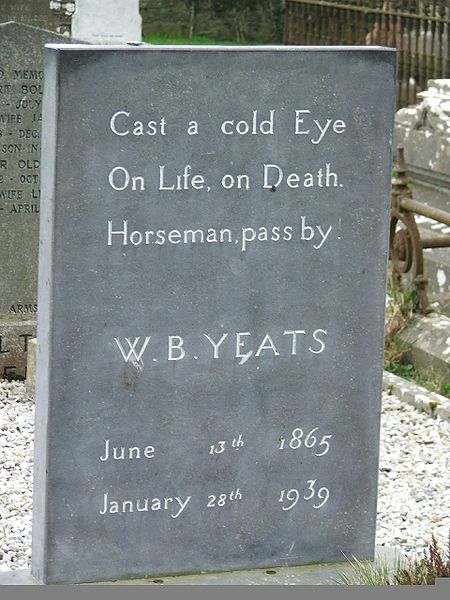
Zbigniew Herbert is a ding an sich, cast a cold eye kind of guy. Many of his poems have him reckoning with objects – buttons… or pebbles:
Pebble
The pebble
is a perfect creature
equal to itself
mindful of its limits
filled exactly
with a pebbly meaning
with a scent that does not remind one of anything
does not frighten anything away does not arouse desire
its ardour and coldness
are just and full of dignity
I feel a heavy remorse
when I hold it in my hand
and its noble body
is permeated by false warmth
— Pebbles cannot be tamed
to the end they will look at us
with a calm and very clear eye
****************************
Herbert’s one of many poets attracted to the impassive enduring thingness of the world; our childish passions do us in; they need tempering by the earth.
And yet, in words very similar to Camus’ (“[O]ne must keep intact in oneself a freshness, a cool wellspring of joy, love the day that escapes injustice.”), Herbert also writes:
beware of dryness of heart love the morning spring
the bird with an unknown name the winter oak
light on a wall the splendour of the sky
they don’t need your warm breath
they are there to say: no one will console you
The pebble doesn’t need your warmth; nature doesn’t need your warmth. Nature’s not going to reach out and touch you…
Somehow you have to toughen yourself up to something approaching a pebble … a pebble with a heart in it… Keep a calm clear and cold eye. A dry eye. But not a dry heart.
Or, as Flaubert said, we should be “equal to our destiny, that’s to say, impassive like it.” Even with a beating heart.
Keep your mind in hell, and despair not.
Dr. Bernard Carroll, known as the "conscience of psychiatry," contributed to various blogs, including Margaret Soltan's University Diaries, for which he sometimes wrote limericks under the name Adam.
New York Times
George Washington University English professor Margaret Soltan writes a blog called University Diaries, in which she decries the Twilight Zone-ish state our holy land’s institutes of higher ed find themselves in these days.
The Electron Pencil
It’s [UD's] intellectual honesty that makes her blog required reading.
Professor Mondo
There's always something delightful and thought intriguing to be found at Margaret Soltan's no-holds-barred, firebrand tinged blog about university life.
AcademicPub
You can get your RDA of academic liars, cheats, and greedy frauds at University Diaries. All disciplines, plus athletics.
truffula, commenting at Historiann
Margaret Soltan at University Diaries blogs superbly and tirelessly about [university sports] corruption.
Dagblog
University Diaries. Hosted by Margaret Soltan, professor of English at George Washington University. Boy is she pissed — mostly about athletics and funding, the usual scandals — but also about distance learning and diploma mills. She likes poems too. And she sings.
Dissent: The Blog
[UD belittles] Mrs. Palin's degree in communications from the University of Idaho...
The Wall Street Journal
Professor Margaret Soltan, blogging at University Diaries... provide[s] an important voice that challenges the status quo.
Lee Skallerup Bessette, Inside Higher Education
[University Diaries offers] the kind of attention to detail in the use of language that makes reading worthwhile.
Sean Dorrance Kelly, Harvard University
Margaret Soltan's ire is a national treasure.
Roland Greene, Stanford University
The irrepressibly to-the-point Margaret Soltan...
Carlat Psychiatry Blog
Margaret Soltan, whose blog lords it over the rest of ours like a benevolent tyrant...
Perplexed with Narrow Passages
Margaret Soltan is no fan of college sports and her diatribes on the subject can be condescending and annoying. But she makes a good point here...
Outside the Beltway
From Margaret Soltan's excellent coverage of the Bernard Madoff scandal comes this tip...
Money Law
University Diaries offers a long-running, focused, and extremely effective critique of the university as we know it.
Anthony Grafton, American Historical Association
The inimitable Margaret Soltan is, as usual, worth reading. ...
Medical Humanities Blog
I awake this morning to find that the excellent Margaret Soltan has linked here and thereby singlehandedly given [this blog] its heaviest traffic...
Ducks and Drakes
As Margaret Soltan, one of the best academic bloggers, points out, pressure is mounting ...
The Bitch Girls
Many of us bloggers worry that we don’t post enough to keep people’s interest: Margaret Soltan posts every day, and I more or less thought she was the gold standard.
Tenured Radical
University Diaries by Margaret Soltan is one of the best windows onto US university life that I know.
Mary Beard, A Don's Life
[University Diaries offers] a broad sense of what's going on in education today, framed by a passionate and knowledgeable reporter.
More magazine, Canada
If deity were an elected office, I would quit my job to get her on the ballot.
Notes of a Neophyte