… back in the ‘forties. It put you right in the heart of historical events. UD wants to put you – rhetorically – in Tuscaloosa, Alabama, site of the Nick Saban Football Academy, where the reaction to the university giving a big scholarship to a student who just before his sophomore year drives drunk all over Tuscaloosa is not to worry about the well-being of your town but immediately to go to whether his absence from the team (assuming Saban suspends him even for one game) will doom your championship prospects. Headline in local paper:
NOW YOU CAN PANIC: GENO SMITH ARRESTED FOR DUI
Smith is certain to miss playing time early in the season. His absence may not be particularly noticeable in the Virginia Tech season opener, despite the fact that Smith is an excellent tackler and excels in run support. However, that September 14 game against the manically-airborne Aggies in Kyle Field will get a whole lot tougher if Smith misses any appreciable playing time.
No, not even a decent interval during which we ask ourselves whether a scholarship to someone who almost certainly won’t graduate and who drives drunk is altogether seemly…
Tuscaloosa, Alabama. You Are There.
I was just now watching, on YouTube, a very dull adaptation of To The Lighthouse. Mr UD called me, on his way back from evening mass at Georgetown University, and said Go outside and look at the moon. I’m becoming a moon worshipper.
As I walked out of the house, I saw, in the evening light, a blue jay feather on the doorstep. It looks exactly like this.

I continued out to the middle of Rokeby
Avenue to see the moon.
It looks exactly like this:

On a cool summer night with crickets.
What’s next for Evan Dobelle? He has spent his way through the University of Hawaii, and through obscure and now much-impoverished Westfield State. Like Patricia Slade at Texas Southern University and Peter Diamandopoulos at Adelphi University, Dobelle arrives at obscure schools with his chest thrust out and starts talking about his important connections and how unless your school gives the president wads of cash for luxury goods no one will respect you.
Dobelle spent more on [a] 2008 Asia trip alone than the $92,000 that Governor Deval Patrick spent to take two dozen officials on a trade mission to Britain and Israel in 2011. But Dobelle said the only unusually expensive item was the luxury hotel bill in Bangkok, and there was a reason for it: The consultant who helped plan the trip said that Thai officials wouldn’t take Westfield State seriously if they didn’t put on a good show.
“She would say, ‘Who the f— will come and listen to Westfield State when they only have time for Cornell? You better set yourself up in a way to show a certain degree of prominence and respect to them,” recalled Dobelle. “So fine, that’s what we did.”
Verbatim out of the Slade/Diamandopoulos book of you gotta spend money on me to make money. They all peddled this line, as did way-high-living American University president Benjamin Ladner.
Todd Wallack, Lesley Cohen Berlowitz’s nemesis at the Boston Globe, contributed to its detailed account of Dobelle’s doings. Wallack seems to be making a specialty of swinish academic administrators. He’ll always be able to find work. Just in the eastern seaboard area.
Dartmouth boy stands at the foot of the bed,
Drops on a woman his little gold thread.
Hush! Hush! Stop him who dares!
Christopher Robin is saying his prayers.
God bless rummy! I know that’s right.
Wasn’t it fun drinking rum tonight?
The beer’s so cold, and the rum’s so hot.
Oh God bless vodka – I quite forgot.
I know it will make her get even more sore
If I pull out my pecker a little bit more.
It’s a beautiful red and it hasn’t a hood.
God bless my pecker; it’s so damn good.
It’s so damn good as I stand by the bed
And pull it out further right over her head
And I shut my eyes and I squeeze my hose
And I wet the woman from head to toes.
Oh Thank you God for a lovely day
And what was the other I had to say?
I said “Bless Rummy,” so what can it be?
Oh! Now I remember it. God bless Me.
Dartmouth boy stands at the foot of the bed,
Drops on a woman his little gold thread.
Hush! Hush! Stop him who dares!
Christopher Robin is saying his prayers.
For a warm, musing, quiet time, a time when things slow down or stop, a poem by Stanley Kunitz, full of quiet musing. UD stops the poem when she feels like it, thinking aloud about its form and its meanings.
The Abduction
Some things I do not profess
to understand, perhaps
not wanting to, including
whatever it was they did
with you or you with them
that timeless summer day
when you stumbled out of the wood,
distracted, with your white blouse torn
and a bloodstain on your skirt.
[This is a wispy, thin-lined, first-person account – directed to a man’s lover – of a memory involving her that continues to baffle and unnerve him. The thinness of his poetic line, and his opening admission of his inadequacy, create a mood of lassitude, vagueness, half-thereness. The poem will be a narrative – the story of the lover’s abduction – but it will be told in the sketchy thin-lined manner of a man in fact defended against the story’s meanings.
We are in a fog, in short, of the sort one knows from Kafka stories, or from novels like The Good Soldier. It’s the condition – the pathology – of not knowing that interests writers like these.
That summer day on which the abduction took place was “timeless,” which is to say it has made on the speaker (and presumably his lover) a permanent mark; they both return to it again and again in memory and in desire. Timeless too in the sense that the events the poet is about to recount seem mythic, unreal, out of time altogether, some miraculous break in the fabric of time. Think here of that unnerving Australian film, Picnic at Hanging Rock which also features virginal women in white dresses “taken” by an alien force, taken out of time.
Here the lover returns from her abduction, spilled sexual blood on her whiteness…]
“Do you believe?” you asked.
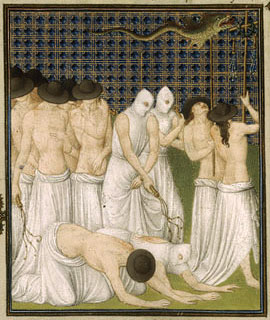
[Do you believe the transformation that has happened to me? Do you love me enough to believe the bizarre tale I’m about to unfold? To believe my way of knowing/not knowing what has happened to transform me from white to red? To love is to enter into the deepest, most wounded, most obscure mental world of the loved one, as in this poem, by Stephen Spender. Or this one, by Richard Wilbur. Are you willing to do that?]
Between us, through the years,
we pieced enough together
to make the story real:
[This is love: That together you give life and even plausibility to… hell, you honor the particular myths, repetition compulsions, odd ways of making sense of one’s destiny, that the loved one has generated out of her experience, her imagination, her – to anticipate the end of this poem – rapture and dread.]
how you encountered on the path
a pack of sleek, grey hounds,
trailed by a dumbshow retinue
in leather shrouds; and how
you were led, through leafy ways,
into the presence of a royal stag,
flaming in his chestnut coat,
who kneeled on a swale of moss
before you; and how you were borne
aloft in triumph through the green,
stretched on his rack of budding horn,
till suddenly you found yourself alone
in a trampled clearing.
[So here’s the medieval myth itself, the way-weird account of her torn and bloodied self she offers the lover. The hunting dogs first appear, and then what sounds like flagellants, and they all lead her to a major stag who stretches her on his “budding horn.” Here is her dream of her triumphant sex, her initiation into the power (“kneeled… before you”) of her own body.]
That was a long time ago,
almost another age, but even now,
when I hold you in my arms,
I wonder where you are.
[Same thing Spender and Wilbur wonder, gazing at their lovers. If these men are going to get anywhere near where these women are, they will indeed have to “believe,” have to enter lovingly into the far country that is the soul of any other human being. The poet feels his inability/unwillingness to enter the deepest, strangest, sources of this woman’s being; yet, loving her, he wonders.]
Sometimes I wake to hear
the engines of the night thrumming
outside the east bay window
on the lawn spreading to the rose garden.
[There is a world inside the world, as Don DeLillo has Lee Harvey Oswald repeat to himself throughout Libra; there is that realm of power, of being, that thrums through our existence, a constant dark engine pulsing through us, making us and making our lives, generating our stories. You can be upbeat about this, and suggest that eventually we can have access to these deep sources of ourselves and even others:
… then he thinks he knows
The hills where his life rose,
And the Sea where it goes.
Or you can be far less upbeat:
…in time,
We half-identify the blind impress
All our behavings bear, may trace it home.
But to confess,
On that green evening when our death begins,
Just what it was, is hardly satisfying,
Since it applied only to one man once,
And that one dying.]
You lie beside me in elegant repose,
a hint of transport hovering on your lips,
[A hint of transport hovering — always an allusion, in her repose, to that transformative mythic moment of transport which has nothing to do with her lover.]
indifferent to the harsh green flares
that swivel through the room,
searchlights controlled by unseen hands.
[Always, ecstatically, she returns to her primal triumph, and this in some sense protects her from the harsh temporal material world that seeks her out, seeks to awaken her to the end of power, eros, solace.]
Out there is a childhood country,
bleached faces peering in
with coals for eyes.
Our lives are spinning out
from world to world;
the shapes of things
are shifting in the wind.
What do we know
beyond the rapture and the dread?
[Outside their bedroom rages a world of monsters out of childhood; outside their haven of life intensified lies death (bleached faces… with coals for eyes), and even as she circles endlessly into her glorious scene of transformation, she – and he – are being otherwise transformed, spun out from the world of life into the world of death.
So this is where we are; this is all we know — the rapture of our death-defying embrace of existence, and the dread of our knowing/not wanting to know how this compulsively reiterated erotic fable will end.]
… but when four heavily recruited football players show up for their first semester and almost immediately team up to rape an unconscious student and photograph themselves doing it (these are the charges), your school has just caught and begun to run with the Penn State pass, and there’s nothing your pleading can do about it.
It’ll be a long carry, in part because Vanderbilt is one of the few remaining morally and academically respectable big-football schools in America, so there’s novelty here. Schadenfreude, too. People from all the dirtbag schools will certainly enjoy smearing shit on clean-as-a-whistle Vandy. And as the trial gets going (if there’s a trial) we’ll get all the Steubenvillesque details.
Yes, Vandy’s new to this, so maybe it thinks dismissing these people from the team and protesting the school’s innocence in the matter (Recruit predators? Us?) will do the trick. Learning curve time.